
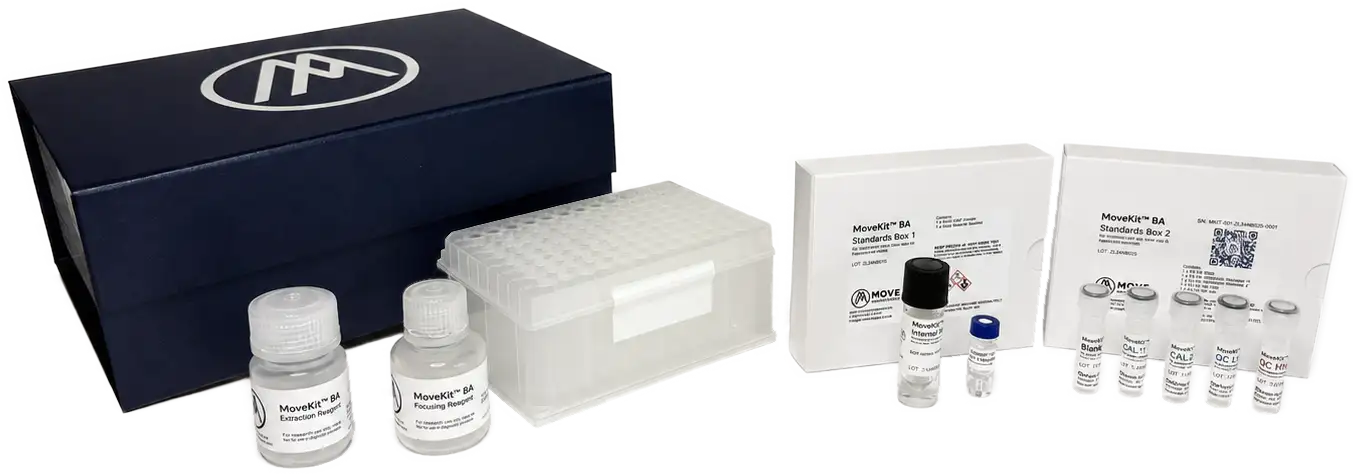
Move Analytical Launches MoveKit™ BA: a Complete Bile Acid Workflow
FOR IMMEDIATE RELEASE
32 Species Quantified Across Four Molecular Classes, Sulfates Included, with 151 More from the Same Injection. 183 targets from 20 µL of plasma, serum, urine, cecum or feces. Thirty-minute prep, no derivatization, software that assigns the peaks, and high-resolution data built for future discovery. Launched on stage at ASMS 2026 in San Diego.
Download the short-form release for media (PDF)
CARRBORO, N.C. — September 21, 2026 — Move Analytical announced the general availability of MoveKit™ BA (P/N MKIT-003), an end-to-end LC-MS bile acid metabolomics kit that quantifies 32 bile acids across four molecular classes and adds semi-quantitative measurement of another 151 microbially conjugated bile acids and free fatty acids — 183 targets in total, from a 20 µL sample, at under $40 per sample.
The announcement came as the mass spectrometry community gathered in San Diego for ASMS 2026, where Move Analytical co-founder and Operations Lead Will Thompson formally launched the kit on stage in the Thermo Fisher Scientific hospitality suite, with a talk highlighting the new capabilities the workflow brings to bile acid research.
This is the workflow we always wished we could hand a collaborator — the standards, the software and the method, matched to each other and proven across five laboratories. ASMS is where this community comes together, and there is no better place to show what it can do.
Will Thompson, co-founder and Operations Lead, Move Analytical
MoveKit BA ships as a complete workflow rather than a target list. Calibrators, quality controls, internal standards and system suitability standards come in the box, matched to the method. MoveApp, the software that accompanies them, runs the data checks, monitors QC longitudinally and assigns the peaks — and exports the whole pipeline to Skyline, so every assignment is inspectable (if desired) and overridable (if warranted). Sample preparation takes thirty minutes and requires no derivatization, roughly eight times faster than conventional bile acid prep.
For biologists: the whole bile acid pool, sulfates and all
Bile acids are now read as signaling molecules acting through FXR and TGR5, and as the most legible chemical record of what the gut microbiome is doing to its host. Much of the most consequential chemistry — sulfation, microbial reconjugation, bacterial oxidation — has simply been difficult to measure routinely. MoveKit BA was built to change that.
The kit quantifies the classical pool — the unconjugated acids (CA, CDCA, DCA, LCA, UDCA, beta-MCA) and their glycine and taurine conjugates (GCA, GCDCA, GDCA, GLCA, GUDCA, TCA, TCDCA, TDCA, TLCA, TUDCA) — and, in the same injection, the 3-sulfates of every one of those species: sixteen sulfated targets across two further molecular classes, the broadest sulfated and modified bile acid coverage of any commercial workflow.
Sulfation is the body’s principal route for detoxifying and excreting the most cytotoxic bile acids, and Move Analytical’s multi-site data show it is not a trace phenomenon. In the material used for the company’s five-laboratory study, three of the ten most abundant analytes in the entire panel were sulfates — GDCA-3S, GLCA-3S and GCDCA-3S, the first of them present at a higher concentration than every classical conjugate except GCDCA. Summed, the sulfated conjugates slightly exceeded the entire classical glycine- and taurine-conjugated pool (approximately 1,035 nM against 975 nM). Measuring both halves together means detoxification and clearance can be read as distinct processes rather than folded into a single number.
The 151 discovery targets extend the panel deep into microbial territory: amino acid conjugates such as Ala-CA, Ala-LCA, Arg-CDCA and Arg-UDCA; the oxo- and iso-species produced by bacterial reduction (isoLCA, alloisoLCA, dehydroLCA, 6oxoLCA, 7oxoLCA, 12oxoLCA); glucuronidated forms; and free fatty acids from FFA 16:0 through FFA 22:6.
That extended coverage tracks where the field is moving. Lithocholic acid was shown in Nature to phenocopy the anti-aging effects of caloric restriction (Qu et al., 2024) — and LCA, its glycine and taurine conjugates and its 3-sulfate are all quantitative targets in MoveKit BA, a distinction that matters because free LCA and its sulfated clearance product are not interchangeable readouts. In inflammatory bowel disease, whether conjugated bile acids help or harm appears to hinge on the balance between microbial conjugation and hydrolysis (Nature Communications, 2025) — a question that can only be asked when conjugated and unconjugated species are measured together. Microbiome-derived bile acid signatures in infancy have been associated with islet autoimmunity and the onset of type 1 diabetes; bile acid composition and signaling are increasingly treated as active mediators of MASLD rather than passive markers of severity; and distinct bile acid signatures in plasma and CSF are emerging in cognitive decline, with secondary-to-primary ratios gaining ground as a general readout of dysbiosis.
Every one of those findings depends on distinguishing molecules that differ by a single hydroxyl, a sulfate, or which amino acid a bacterium stuck on the end. That is a solved analytical problem. It just wasn’t a solved workflow problem, and that is the part we built.
Scott Mellors, co-founder and Science Lead, Move Analytical
The kit is validated on plasma, serum, urine, cecum and feces, with additional matrices in development — the same panel across host circulation and the gut lumen, which is what a microbiome–host study needs.
Targeted rigor without closing the question
The reason MoveKit BA can offer 151 discovery targets alongside 32 quantified ones is the acquisition itself. The primary method runs on high-resolution accurate-mass instruments, acquiring full-scan data rather than a fixed list of transitions. Targeted quantification and untargeted coverage come out of the same injection, on the same 20 µL of sample, with the same internal standards: laboratories get calibrated concentrations for the analytes they came for, and an accurate-mass record of everything else that eluted.
That record keeps its value. As new microbial conjugates continue to be described — and the recent literature suggests the list is nowhere near closed — full-scan files can be re-interrogated, so samples archived today remain answerable to questions that have not been posed yet, without going back to the freezer.
For laboratories whose priority is targeted throughput, the kit also runs on the Thermo Scientific Stellar MS, and the company’s multi-site study covered both platforms.
For core labs: 89 samples a batch, and no manual integration
MoveKit BA is designed around what core facilities are measured on: throughput, turnaround and analyst time. A kit runs 89 samples per batch and can be run in partial batches, so a small pilot does not cost a full kit. Internal standards are supplied by Cambridge Isotope Laboratories, the method was developed in partnership with Thermo Fisher Scientific, and platform deployment is same-day.
The software is the part core labs tend to notice first.
The app assigned 100% of the peaks correctly. I had to do zero manual integration.
Crystal Pace, UNC MAP Core
MoveApp evaluates system suitability and QC as the run proceeds, so sample preparation and instrument problems surface while there is still time to act on them — not after the batch has finished.
It was a one to two minute decision to know I needed to rerun.
Zachary Davis, West Coast Metabolomics Core at UC Davis, describing catching a sample preparation error through the QC monitoring workflow
Reproducible across sites, and across instrument classes
Move Analytical has completed a cross-laboratory study of MoveKit BA with participating laboratories at Corewell Health, UMass Chan Medical School, the University of Colorado Boulder, the UNC MAP Core, and the West Coast Metabolomics Core at UC Davis.
For analytes quantified at all five high-resolution sites, the median inter-laboratory CV was 15.9% — spanning all four molecular classes, sulfates included — and sites running the Stellar MS returned mean concentrations agreeing with the high-resolution platforms within 10% for analytes across every class.
That consistency is what the integrated design exists to deliver — the same kit, the same calibrators and the same automated peak assignment at every site — and it is the precondition for pooling bile acid data across a consortium or a multi-center trial. Detailed performance data are available from the company.
Availability
MoveKit BA (P/N MKIT-003) is available now at $3,500 per kit, which covers 89 samples — under $40 per sample. It joins MoveKit™ CE (MKIT-001) for ZipChip® CE-MS metabolomics and MoveKit™ Reference Material 1 (MKIT-002). Full analyte lists and quote requests are at moveanalytical.com. ASMS 2026 attendees can hear Thompson introduce the workflow at the Thermo Scientific hospitality suite; a recording of the talk will be made available following the conference.
About Move Analytical
Move Analytical builds software-defined metabolomics: tightly integrated kits, standards and software that remove complexity from laboratory workflows so scientists can focus on the science. The company was founded by Will Thompson (Operations Lead), Scott Mellors (Science Lead), James P. Campbell (Software and AI Lead) and Michael Ramsey (Strategic Lead), whose combined experience spans quantitative metabolomics, analytics and entrepreneurship.
Michael Ramsey is the Minnie N. Goldby Distinguished Professor of Chemistry at the University of North Carolina at Chapel Hill and a member of the National Academy of Engineering. A pioneer of microfluidics and lab-on-a-chip analytical systems, he developed the microchip capillary electrophoresis technology that underpins the ZipChip CE-MS platform and is the scientific founder of 908 Devices.
Move Analytical products are made in Carrboro, North Carolina.
Media contact
Move Analytical [email protected] moveanalytical.com
###
ZipChip® is a registered trademark of 908 Devices. Thermo Scientific and Thermo Fisher Scientific are trademarks of Thermo Fisher Scientific Inc. Cambridge Isotope Laboratories is a trademark of Cambridge Isotope Laboratories, Inc.